


A matter of trust: The U.S. should stop pushing away its allies | Column
A matter of trust: The U.S. should stop pushing away its allies | Column

William McQuilkin Sun, September 6, 2026 at 9:31 AM UTC
0
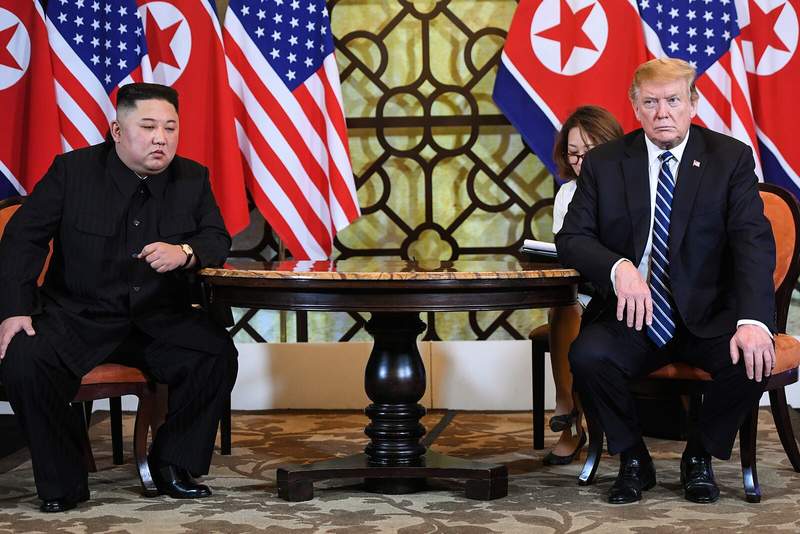
President Donald Trump and North Korea's leader Kim Jong Un meet during the second US-North Korea summit in 2019. ©Saul Loeb/AFP
Having served in South Korea while in uniform, I was disappointed recently to see the Trump administration scaling back, on short notice, long-planned military exercises with Seoul. President Donald Trump cited his good relationship with Kim Jong Un, the North Korean leader and criticized South Korea for not assisting the U.S. in the war with Iran. I have personally participated in these types of exercises. They act as a strong deterrent, improve readiness and strengthen the bonds of friendship with a trusted ally.

William McQuilkin
Leaving aside for a moment that North Korea has developed nuclear weapons and long-range ballistic missiles that can hold our allies and bases in the Pacific at risk, these actions represent what I think is a disturbing trend — the bullying and coercing of trusted, long-standing U.S. allies.
When we weaken trust in U.S. alliances, we make America less strong. Trust is the coin of the realm in military, economic and diplomatic relationships. As one former NATO colleague told me, “The thing about trust is, once it is gone, it is gone. And trust between nations is comparable to trust between people. If you feel betrayed once, it can never return to the same level.”
Earlier this year, right after the U.S. captured Nicolas Maduro in Venezuela, President Trump started talking about the need to annex Greenland, angering both Greenlanders and Denmark, one of our strongest allies. The White House put out a statement on Greenland that it was considering “a range of options,” including military force.
These are not serious people. Any attack on Greenland by the U.S. would invoke NATO’s Article 5 protections (Article 5 states that “an armed attack against one or more of them in Europe or North America shall be considered an attack against them all”) and would essentially be the end of the strongest, most successful security alliance the world has ever known.
Next came the nonsense of saying that Canada would be better off as the 51 state and with whom we are now engaged in an unnecessary and illogical trade war. Canada is our nation’s second-largest trading partner. As in the Greenland and Denmark example above, this is for Canada, about national sovereignty. The renaming of Lake Ontario to Lake America barely deserves mention except in the vein of the unseriousness mentioned above.
Secretary of Transportation Sean Duffy said when referring to the trade war with Canada that it is “a country that doesn’t have a military. … We provide their security for them, and they take advantage of us.”
Try telling that to Canadian families who lost 158 brave soldiers supporting the war in Afghanistan.
Advertisement
I have personally operated with and sailed on ships of the Royal Canadian Navy. I remember when serving with the NATO’s Standing Naval Force Atlantic, the Canadian ship HMCS Fredericton was selected as the flagship for an engagement and port visit to Nouakchott, Mauritania. In addition to the ship’s fine operational reputation and demonstrated success at sea, they spoke French which turned out to be critical to the success of the mission. The ship and crew performed tremendously.
I have previously written about the importance of allies and have warned that unless we shored up our alliances, we ran the risk of our allies developing hedging strategies against the United States. I think we are now there, especially with respect to Denmark and Canada.
Our actions regarding South Korea are equally troubling. The U.S. government has long sought to limit the spread of nuclear weapons. President Trump’s recent statement that North Korea possesses “57 very powerful nuclear weapons” but not mentioning denuclearization as a U.S. policy goal is problematic. To review the bidding, North Korea is an adversary supplying troops to Russia to fight in the war against Ukraine. South Korea has been a trusted ally for over 70 years.
Returning to my opening objections of canceling long-planned exercises with South Korea and chiding the South Korean President Lee Jae-myung for not joining the U.S. in the war with Iran, all the while making overtures to Pyongyang, just sends the wrong message. It is not only irresponsible in my judgment but could lead South Korea to conclude that they should also acquire nuclear weapons.
Alliances matter, full stop. These are fragile relationships built on trust and require constant attention. Maintaining a strong alliance takes a lot of work. The fact that our U.S. alliances have endured for so long is not an accident.
Currently some of our allies are moving away from us. We are pushing others away. This is a strategic mistake, and we are surrendering a major instrument of U.S. national power in the process. We will have to work much harder to repair these relationships. We build strong ties with our allies because sometimes we need to be able to push and pull within these trusted relationships. But we don’t need to create friction points where none are warranted.
Let us cross that Peace Bridge with Canada, literally and figuratively. And let us also tend to those mooring lines of trust with our other allies, thus better securing our freedom and our future.
William McQuilkin is a retired U.S. Navy rear admiral who served as the Director of the Strategy and Policy Division on the U.S. Navy staff in the Pentagon and was a former commander of U.S. Naval Forces Korea.
Source: “AOL Breaking”
